How to Make Tea Houses Popular Again
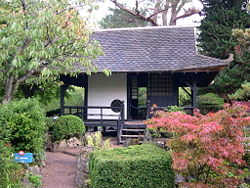
Japanese way tea firm at The Irish gaelic National Stud, Tully, Kildare, Ireland.
A tea house or tearoom is a venue designed for people to gather for the purpose of drinking tea, often combined with other activities. Their office varies widely depending on the culture. As teas of different kinds became popular throughout the globe through the centuries, they became not just drinks to accompany meals in homes or restaurants, but a tea civilisation emerged which included venues designed specifically effectually the serving and drinking of tea.
Contents
- 1 History
- 2 Asia
- 2.1 China
- 2.two Nihon
- 2.3 Korea
- 3 Uk
- 4 United states
- 5 Other
- 6 References
- 7 External links
- 8 Credits
The grade of a tea house or room varies considerably, just every bit the occasions upon which tea is served vary both within and across cultures. From the simple tea and snack at home or as a break from work or shopping, to the relaxed social gatherings of women, to meetings where business or politics may be agreed upon, to the formal tea ceremony in Japan, the serving of tea has a multitude of purposes and styles that bridge so many aspects of life. Human creativity has used the various occasions in which tea is served and consumed to construct buildings appropriate to each of these occasions, buildings which reflect the concrete, social, and spiritual elements that are involved in the activities.
History
Tea houses developed around the earth every bit the drinking of tea became popular. Business has been conducted while sharing tea together, formal rituals and ceremonies have developed surrounding tea drinking, and it has long been socially acceptable for women to assemble unaccompanied past their husbands or chaperones when the purpose revolves around drinking tea.
In Cathay, during the fourth and fifth centuries tea plantations flourished and tea became a pleasurable drinkable rather than a medicinal tonic. Its drinking became a social event with complex rituals and ceremonies. During the Song Dynasty (960-1279 C.E.) the tea house became a focus of social life, a place where business organization could be conducted, entertainment by professional storytellers, jugglers, poets, and actors could be enjoyed, and friends and families could relax and take casual conversation (Pettigrew and Richardson 2008).
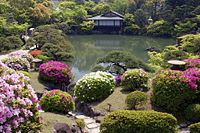
Sorakuen in Kobe, Hyogo prefecture, Japan
In Japan, the tea anniversary, perfected and popularized by Sen no Rikyu in the sixteenth century, required the use of a special tea house or tearoom. These were often built in traditional mode and surrounded by beautiful, peaceful gardens. In this style the Japanese elevated the Chinese ritual into a form of beauty and fine art, during which they sought to "remove themselves from the details of daily life and experience a pure and untainted sagelike experience of otherworldly peace" (Heiss and Heiss 2007).
Since 1638, when the Mongolian ruler Altyn Khan ("Gold Khan") gave a gift of tea to the Russian Arbiter, Mikhail I Fyodorovich Romanov, tea has had a rich and varied history in Russia (Heiss and Heiss 2007). Information technology became one of the most pop beverages in the country and is closely associated with traditional Russian culture. The ubiquitous Russian tea brewing device, known equally a samovar, has become a symbol of hospitality and comfort. Tea is a family effect, and is usually served after each repast with sugar and lemon (but without milk), and an assortment of jams, pastries, and confections. Special tearooms, however, did non develop; rather the samovar was to be found in banquet rooms, restaurants, and in the home. The well-known Russian Tea Room of New York City, opened in 1927 by Russian expatriates, is a eatery serving a total menu of meals, non merely a tea house.
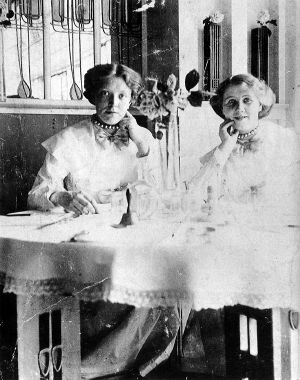
Miss Cranston'south waitresses, seen in the Room de Luxe of the Willow Tea Rooms.
In eighteenth century Great britain, tea drinking had become a popular attribute of the gardens in London, only the expansion of buildings reduced the available space for such activities. Tearooms began to appear in Glasgow, pioneered by Catherine Cranston, and then in London when the Aerated Bread Visitor began to serve cups of tea at its establishments. In the cities other companies apace opened tearooms, and in rural areas farmers' wives began serving tea and baked goods to travelers (Pettigrew and Richardson 2008). In the early on twentieth century after the close of the Victorian era, stylish living became popular, and fine hotels served tea in the afternoon accompanied by music and dancing. Such activities diminished with the two World Wars, and coffeehouses and cafes became more popular. The introduction of American fast food restaurants completed the demise of the tea room.
In the United States in the twentieth century, Prohibition, the machine, and the rising independence of women led to the opening of tearooms around the land. They were as varied in fashion as the women who ran them. Artists and entrepreneurs set up bohemian gathering places for their friends and colleagues; stylish, elegant establishments were pop with the wealthy; others invoked cultural or literary themes to create an environment and bill of fare attractive to tourists and locals alike. When the fast food restaurant appeared, however, tea numberless, mass produced nutrient, and their standardized environments replaced the charm and individuality of the tearoom.
In Asia the tea business firm never lost its appeal. China boasts the all-time tea houses in the world, and the city of Chengdu boasts the best tea houses in Cathay, numbering over a thousand such establishments (Gautier 2006). In Japan in the latter role of the twentieth century, Western influence led to the rise popularity of black tea. The result was the opening of British-way tearooms in which tea is served accompanied by sandwiches and scones.
In Europe and the U.s., tea houses and tearooms had lost popularity at that time. However, toward the end of the twentieth century a resurgence of interest in good quality tea accompanied past appetizing baked appurtenances served in a comfortable environment led to the revival of the tearoom and tea house in Britain (Pettigrew and Richardson 2008). Tearooms have emerged in the xx-first century as pop establishments throughout Europe, with elegant tea salons in France and British-fashion afternoon tea served in the finest hotels in Moscow. In the United states, interest in Asian culture brought renewed interest in varieties of teas and ways to relish drinking them. The purported health benefits of tea also fueled interest in new styles of tearoom which offered healthy drinks in a less stressful environment.
Asia
Tea originated in Asia, as did many forms of tea business firm. In India and Sri Lanka, the globe's largest producers of tea, notwithstanding, tea is available everywhere and in that location is no specific tradition or ceremony accompanying information technology. The best cups of tea are to exist institute from samovars in small booths on the street (Gautier 2006).
China
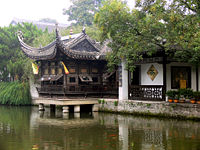
A tea business firm located at Nanjing
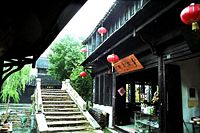
In China, a tea house (茶馆, cháguăn or 茶屋, cháwū) is traditionally quite similar to the American "cafe," albeit centered around tea rather than coffee. People gather at tea houses to chat, socialize, and savor tea.
In Northern Imperial China teahouses were regarded as retreats for gentlemen and after for businessmen. Deals would exist discussed and sealed in the neutral, relaxed surroundings of a teahouse rather than in offices. Some tea houses in Hong Kong notwithstanding uphold such a tradition and are frequented past industrialists and entrepreneurs. Tea houses are besides places where disputes could be settled harmoniously over tea. The Chinese often replaced courts of law with a tea house and the presence of a mutually respected arbiter. The disputing parties would agree on terms and apologies, pay for the tea, milkshake hands, and part in peace.
The Guangdong (Cantonese) fashion tea houses (茶楼, chálou) non only serve tea, simply too dim sum (点心) nutrient. Yum cha (飲茶) is a Cantonese term which means "drink tea" simply as well refers to the custom of eating small servings of unlike foods, known every bit dim sum. It is traditional to yum cha on weekend mornings, and whole families gather to chat and swallow dim sum and beverage Chinese tea. In the by, people went to a tea house to yum cha, but Dim sum restaurants have gained overwhelming popularity. However, the Guangdong mode tea business firm serving dim sum and tea has become popular in other countries, particularly in major cities such equally San Francisco and New York City in the United States.
Japan
In Japan, there are two traditional types of tea house. Rooms where tea ceremonies (cha-no-yu) are performed are known as chashitsu (茶室, literally "tea room"). The ochaya (お茶屋 tea house) traditionally refers to a place of entertainment.
- Chashitsu
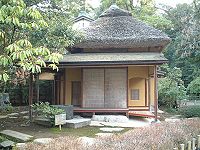
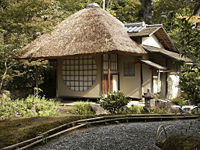
Ihōan at Kōdai-ji in Kyoto
There are two types of chashitsu: costless-standing structures frequently containing several rooms (known as tea houses in English), and rooms located within dwellings or other buildings and set bated for tea ceremony (known in English language every bit tea rooms).
Tea rooms are ordinarily small, and are found inside tea houses every bit well every bit in private homes, temples or shrines, schools, and other institutions. In Japanese homes, any room with a tatami floor may be used every bit a tea room; but the same room may also be used for other purposes.
The design of free-continuing tea houses is heavily influenced by Zen philosophy. Tea houses were first introduced in the Sengoku menses, from the eye of the fifteenth century to the get-go of the seventeenth century. They were built mostly by Zen monks or past daimyo, samurai, and merchants who skilful the tea anniversary. They sought simplicity and tranquility—central tenets of Zen philosophy.
A typical tea firm is surrounded past a modest garden in which there is a waiting area for guests, also every bit a roji (路地), or "dewy path" leading to the tea house. The tea house itself is usually built of wood and bamboo, and the entrance is a modest, square door (the nijiri-guchi) which symbolically separates the minor, simple, quiet inside from the crowded, overwhelming outside world.
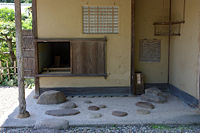
Small entrance nijiri-guchi of a tea house
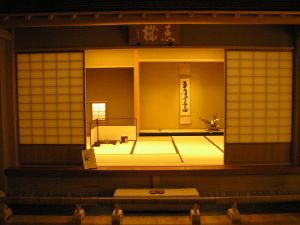
Interior view of a traditional tea room
Tea houses usually consist of two rooms: one, the mizuya, where the host prepares food and snacks and tea supplies are stored, and the other for the belongings of the tea ceremony itself. The primary room is typically extremely small, often iv 1/2 tatami mats (9 feet (two.vii 1000) by ix feet (ii.7 m)), and the ceilings are low. The first tea business firm built according to this configuration was shogun Ashikaga Yoshimasa'southward Ginkaku-ji (Temple of the Silver Pavilion) in Kyoto. This modest room kept the temper intimate and the host and guests closely connected throughout the ritual (Heiss and Heiss 2006).
There is no furniture, except for that which is required for the preparation of tea. There will usually be a charcoal pit (炉, ro) in the center of the room for boiling water for tea.
Guests and hosts sit seiza mode on the floor. At that place is commonly piffling ornamentation. At that place will be a tokonoma (ringlet apse) holding a scroll of calligraphy or brush painting, and perhaps a small, simple, blossom arrangement called a cha-bana (茶花). All materials used are intentionally simple and rustic. All doors and windows are traditional Japanese shōji, made of thin strips of balsa wood covered in a translucent Japanese paper which allows calorie-free from exterior to come into the room. The floor is congenital a few feet higher up the ground in social club to keep the room dry.
The acknowledgment of simplicity and plainness is a central motivation of the tea house. A notable exception is the famous gold tearoom constructed at Osaka Castle by Sen no Rikyu for Toyotomi Hideyoshi, a Sengoku period daimyo who unified Japan. This tearoom had walls, ceiling, pillars, and even tea utensils of gold (Varley and Isao 1995).
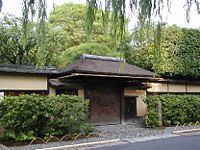
The Kabuto Mon archway to the Urasenke Konnichian in Kyoto
Tea houses were traditionally located in remote, quiet areas, but today are more likely to exist found in the gardens or grounds of larger houses, or in public or private parks.
Very big tea houses, such equally those that tin be establish in parks or those maintained by large tea schools, such as Urasenke, may have several tea rooms of unlike sizes; a large, well-equipped mizuya resembling a modern kitchen; a large waiting room for guests; a welcoming area where guests are greeted and tin can remove and store their shoes; separate toilets for men and women; a changing room; a storage room; and possibly several anterooms. Such tea houses tin adjust dozens of guests and several simultaneous tea ceremonies, and may take a total flooring surface area exceeding 60 mats.
- Ochaya
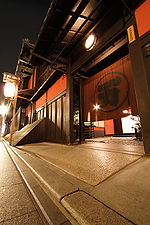
The entrance of the Ichiriki Ochaya
In Japan a tea firm (お茶屋, ochaya) can likewise refer to a place of entertainment with geisha and are typically very exclusive establishments. Ochaya are more often than not wooden, traditional structures. Their windows have lattices (bengara goshi) on the footing flooring and reed screens (sudare) on the kickoff floor to protect the privacy of their clients.
The origin of the modern ochaya dates back to 1712, when the Tokugawa Shogunate gave licenses to the ochaya of Gion to provide geisha entertainment. Geisha, known for their singled-out make-up and attire, their elegant and graceful trip the light fantastic, and their demure conversation, entertain their clients with song, trip the light fantastic toe, and poetry, also offering nutrient, drink, and chat.
The Ichiriki Ochaya (translated Ichiriki Teahouse) is ane of the most famous and historic ochaya in Kyoto. It is over 300 years sometime, and has been a major centerpiece of Gion since the offset of the entertainment commune. The Ichiriki has traditionally entertained those of political and business ability. It is an sectional establishment, very costly, and access is past invitation but.
Korea
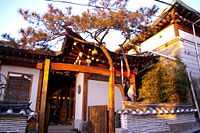
A tea house in Insadong, Seoul, Korea.
Primal to the Korean approach to tea is an piece of cake and natural coherence, with fewer formal rituals, fewer absolutes, greater freedom for relaxation, and more creativity in enjoying a wider multifariousness of teas, services, and chat. The master element of the Korean tea ceremony is the ease and naturalness of enjoying tea inside an easy formal setting.
This leads to a wider variance of teahouse design, tea garden entries and gardens, different utilize and styles of teawares, and regional variations in choice of tea, choice of cakes and snacks, seasonal and temporal variations, and the acoustic and visual ambiance of Korean teahouses. Some of the best Korean teahouses had their ain minor springs which provided the water for the tea.
Uk
In the United kingdom of great britain and northern ireland, a tearoom is a small room or restaurant where beverages and light meals are served, frequently catering importantly to women and having a sedate or subdued atmosphere. A client might expect to receive cream tea or Devonshire tea, often served from a prc set, and a scone with jam and clotted foam; alternatively a loftier tea may be served. In Scotland teas are normally served with a diverseness of scones and cakes. In a related usage, a tearoom may be a room set aside in a workplace for workers to relax and have refreshment during piece of work-breaks. Traditionally a staff member serving food and beverages in such a tearoom would have been chosen a tea lady.
At that place is a long history of tearooms in London hotels, a practice which spread throughout the country and continues today. Thomas Twining opened the starting time known tea room in 1706, which remains at 216 Strand, London today. In 1787 the visitor created its logo, yet in utilise today, which is thought to be the world's oldest commercial logo that has been in continuous utilize since its inception (Standage 2006). In 2006, Twinings historic its 300th anniversary, with a special tea, and associated tea caddies.
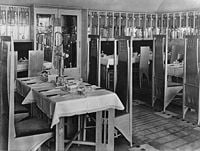
The Room de Luxe in the Willow Tearooms as it was in 1903.
The popularity of the tearoom rose as an alternative to the pub during the temperance motility. In the late 1800s Catherine Cranston opened the kickoff of what became a chain of Miss Cranston's Tea Rooms in Glasgow, Scotland. Miss Cranston had conceived the idea of a series of "art tearooms," venues where people could run into to relax and enjoy non-alcoholic refreshments in a variety of different "rooms" inside the same building. She worked together with internationally renowned builder Charles Rennie Mackintosh to design her tea rooms, which every bit a result made available a unique, avant-garde artistic world to thousands of ordinary people. Their tearooms became internationally famous, with descriptions stating that "Miss Cranston's tea-rooms, designed by Mr. Mackintosh, are reckoned by some of the pilgrims to Glasgow as ane of the sights of the city" (Grigg 1991).

The gallery in The Willow Tearooms.
While other cities offered very expensive and very basic tea rooms by 1901, Miss Cranston set the standard in Glasgow for more welcoming establishments. Rooms were provided for ladies only and for gentlemen only, equally well as dejeuner rooms where they could dine together and smoking rooms and billiard rooms for the gentlemen. Miss Cranston'southward Tea Rooms became social centers for all, for businessmen and apprentices, for ladies and ladies' maids. The Ladies Rooms were a particular success, allowing respectable women to leave and come across together without male company. The last and nigh famous of these establishments, the Willow Tearooms on Sauchiehall Street, with its famous "Room de Luxe" stretching the width of the building, opened for business organisation in Oct 1903 and, following substantial renovation in the 1980s, remains open today. Following her success, like establishments opened throughout Scotland.
Well known chains of tea shops include those of Joseph Lyons and Co., which were originally opened 1894 and finally closed in 1981, and the Aerated Bread Company's tearooms. A.B.C. as it became known is mostly remembered for its chain of self-service tearooms of which the commencement opened in 1865. At its elevation in 1923 information technology had 150 branch shops in London and 250 tea rooms. The Lyons tea shops were slightly more up-market place, and were notable for their interior design, Oliver P. Bernard being consultant artistic director. Before the 2d World War service was to the tabular array past uniformed waitresses, known as "Nippies," but after the War the tea shops converted to cafeteria service. Until the 1940s they had a certain working-course chichi, simply by the 1950s and 1960s they were quick stops for decorated shoppers where one could become a cup of tea and a snack or a inexpensive and filling meal. The tea shops always had a baker counter at the front, and their signs, fine art nouveau aureate lettering on white, were a familiar landmark.

Bettys tea room in Harrogate, Yorkshire.
Bettys Café Tea Rooms are a smaller chain, operating exclusively in Yorkshire. They are traditional tea rooms serving traditional meals with influences both from Switzerland and Yorkshire. The first Bettys tea room was opened on Cambridge Crescent in Harrogate, Due north Yorkshire, past Frederick Belmont, a Swiss confectioner, in July 1919. The Harrogate tea rooms subsequently moved to their current position on Parliament Street.
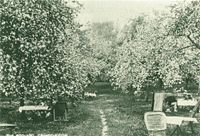
The Orchard in bloom, c. 1910.
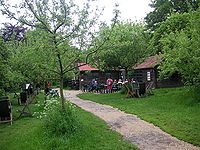
Tea gardens, once popular in London earlier infinite became limited, also operate in some locations. The Orchard opened in 1897 as a tea garden in Grantchester, most Cambridge. A pop retreat for Cambridge students, teachers, and tourists, it includes many famous names among its patrons. The Orchard started when a grouping of Cambridge students asked the landlady, Mrs Stevenson of Orchard House, if they could take their tea in the orchard rather than on the front lawn as the custom was. This practice soon became the norm, and the place grew in popularity. The poet Rupert Brooke took upwards lodging in the firm in 1909. A graduate student of great popularity in the university community at the fourth dimension, Brooke before long attracted a slap-up following at the place, among them Virginia Woolf, John Maynard Keynes, Eastward. M. Forster, Bertrand Russell, Augustus John, and Ludwig Wittgenstein – the so-called Grantchester Group. Today the Orchard is open every day of the year and can be reached both by road from Cambridge or by punt down the River Cam.
United states of america

The Tea Room in the due east section of Norris Dam State Park in Anderson County, Tennessee, in the southeastern United states.
In the 1880s fine hotels in the United States began to offer tea service in tea rooms and tea courts, and by 1910 they had begun to host afternoon tea dances equally trip the light fantastic toe crazes swept the land. As in the United Kingdom, tea houses and tearooms besides became popular in rural areas, offering refreshment to travelers.
Tea houses and tea rooms in the U.s.a. today range from the whimsical Alice'south Tea Loving cup in New York City, where patrons sit at mismatched tables and chairs or lounge on floral banquettes, to the Dushanbe Tea House in Boulder, Colorado, a gift from the sis city of Dushanbe—the majuscule of Tajikistan—created past over twoscore artisans and featuring a hand-carved and paw-painted ceiling, tables, stools, columns, and exterior ceramic panels.
A notable institution is New York's venerable Russian Tea Room, a full service restaurant opened in 1927 by former members of the Russian Imperial Ballet as a gathering place for Russian expatriates and which became famous as a gathering place for those in the entertainment industry. Although caviar has always been featured, nutrient has always been considered 2d to the Russian Tea Room'due south décor—perpetually decked in festive red, green, and gilt with cherry-red carpet, cherry leather banquettes and chairs, eclectic artwork and antiquarian samovars, and etched-glass revolving door. Subsequently being sold, renovated, closing, and sold over again in the xx-first century, the Russian Tea Room continues to exist an iconic landmark of New York city (Kilian 2006).
Other
Around the world, the term "tea house" or "tea room" may be used to refer to a restaurant or Salon de Thé. In the twenty-first century they are thriving. From individual tea houses to franchises with establishments in many cities and fifty-fifty countries, they offer a variety of teas and atmospheres in which to enjoy them. For many, the atmosphere and experience itself is paramount, while for others the quality of the tea and its diverse beverages are the attraction. In others, the convenience of uncomplicated refreshments available while traveling makes a tearoom an attractive feature of tourist locations and parks. Following are some examples.
- Australia
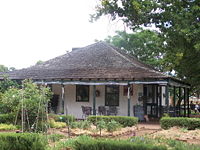
Tearooms are ordinarily found in tourist attractions in Commonwealth of australia as in the United kingdom and onetime colonies. For instance, Tranby House, one of the oldest surviving buildings from the early settlement of the Swan River Colony in Australia, hosts a popular tearoom in one of its original buildings. Named Tranby House in 1929, in recognition of its historical significance, it was opened to the public in 1977, and continues today as a popular tourist attraction and tearoom.
- Middle East
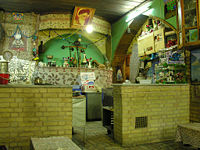
Interior Chaee-Khaneh in Isfahan, Iran
In the Center East, notably in Iran and Turkey, tea houses may exist referred to as Chaee-Khaneh—literally, the "business firm of tea." These tea houses usually serve several beverages including both tea and coffee, and some serve Hookah.
- Tajikistan
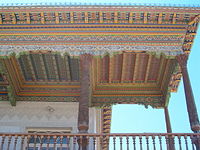
Tea houses are pop and numerous in Tajikistan. They are traditionally busy with Western farsi art, lavish ornament and colour, and the use of motifs from nature. They serve equally social places where friends gather to talk or play chess while drinking tea.
- Egypt
In Egypt, coffee houses are called 'ahwa' and combine serving java too as tea and tisanes. Tea is called shai, and coffee is as well called ahwa. Karkady, or Hibiscus tea, the infusion made from the calyces (sepals) of the Hibiscus sabdariffa flower, is also pop.
- Czech Republic
A tea civilization has developed in the Czech Republic, including many styles of tearooms. Different tea rooms have created various blends and methods of preparation and serving. Dobra Cajovna (also Dobrá Tea, Dobrá čajovna) is a tea house franchise originating in the city of Prague which has since opened in many other cities effectually the globe. Dobrá (meaning "good" in Czech) specializes in serving fine loose-leafage teas brewed and served in the fashion of each tea'southward country of origin, accompanied by pastries, couscous with fruit, spiced pita, and other snacks. There is a diverse choice of teas available, from Indian chai and Darjeeling to Chinese white tea, pu-erh, and Japanese matcha. Aside from the tea itself, Dobra's temper is uniquely peaceful. Rather than promoting the "cup-on-the-run" routine that became the norm in Western cities, Dobra offers calming music and dim lighting, promoting a more than relaxed experience.
- Slovakia
Less visible than in the Czech republic, tea civilisation also exists in Slovakia. Although considered an hush-hush environment past many, tea rooms have appeared in most middle-sized towns. These tea rooms are appreciated for offering tranquility environments with pleasant music. More importantly, they are usually not-smoking, dissimilar most pubs and cafés.
References
ISBN links support NWE through referral fees
- Gautier, Lydia. 2006. Tea: Aromas and Flavors Around the World. San Francisco, CA: Chronicle Books. ISBN 978-0811856829
- Grigg, Jocelyn. 1991. Charles Rennie Mackintosh. Chambers. ISBN 0550225404
- Heiss, Mary Lou, and Robert J. Heiss. 2007. The Story of Tea: A Cultural History and Drinking Guide. Berkeley, CA: 10 Speed Printing. ISBN 1580087450
- Kilian, Cynthia, 2006, 'Russian' Back: Famed Tea Room Set to Reopen New York Post. Retrieved Retrieved Dec 11, 2008.
- Kinchin, Perilla. 1998. Taking Tea with Mackintosh: The Story of Miss Cranston's Tea Rooms. Petulama, CA: Pomegranate Communications. ISBN 0764906925.
- Murphey, Rhoads. 2006. East Asia: A New History, fourth Edition. Longman. ISBN 978-0321421418
- Pettigrew, Jane, and Bruce Richardson. 2008. The New Tea Companion. Perryville, KY: Benjamin Press. ISBN 978-0979343179
- Richardson, Bruce. 2008. Great Tea Rooms of America. Perryville, KY: Benjamin Press. ISBN 978-0979343155
- Richardson, Bruce. 2008. The Great Tea Rooms of United kingdom of great britain and northern ireland. Perryville, KY: Benjamin Printing. ISBN 978-0979343117
- Standage, Tom. 2006. A History of the World in vi Spectacles. New York, NY: Walker Publishing Visitor. ISBN 978-0802715524
- Varley, H. Paul. 2000. Japanese Culture, 4th Edition. Honolulu: Academy of Hawaii Press. ISBN 0824821521.
- Varley, H. Paul, and Kumakura Isao. 1995. Tea in Nippon: Essays on the History of Chanoyu. Honolulu, Hi: University of Hawaii Press. ISBN 0824817176.
External links
All links retrieved January xix, 2020.
- Aerated Bread Visitor (ABC) National Athenaeum (Uk).
- Tranby House gov. of Australia.
- Osaka Castle
Credits
New Earth Encyclopedia writers and editors rewrote and completed the Wikipedia article in accordance with New World Encyclopedia standards. This article abides by terms of the Creative Commons CC-past-sa 3.0 License (CC-by-sa), which may be used and disseminated with proper attribution. Credit is due nether the terms of this license that can reference both the New Earth Encyclopedia contributors and the selfless volunteer contributors of the Wikimedia Foundation. To cite this article click hither for a list of adequate citing formats.The history of earlier contributions by wikipedians is accessible to researchers here:
- Tea_house history
- The_Orchard history
- Dobra_Cajovna history
- Chashitsu history
The history of this commodity since it was imported to New Earth Encyclopedia:
- History of "Tea house"
Notation: Some restrictions may employ to use of individual images which are separately licensed.
Source: https://www.newworldencyclopedia.org/entry/tea_house
0 Response to "How to Make Tea Houses Popular Again"
Post a Comment