Commentary: To its own detriment, the US still doesn’t understand China
Advertisement
Commentary
Commentary: To its own detriment, the US still doesn't understand China
Biden plans to build a concert of democracies to contain China, but this will leave everyone worse off, say Andrew Sheng and Xiao Geng.
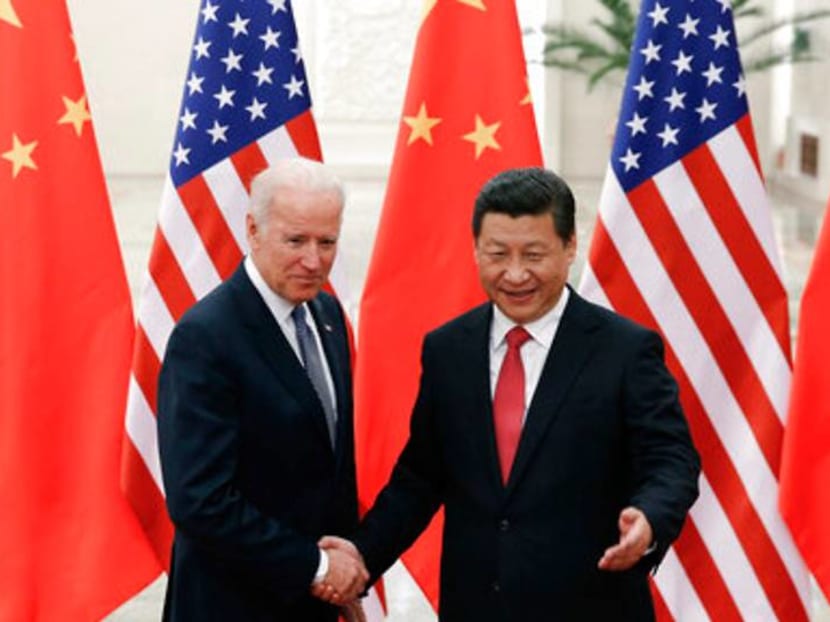
FILE - In this Dec. 4, 2013, file photograph, Chinese President 11 Jinping, right, shakes hands with then U.s. Vice President Joe Biden as they pose for photos at the Slap-up Hall of the People in Beijing. (AP Photograph/Lintao Zhang, Puddle, File)

HONG KONG: Red china is a tough country to encompass – fifty-fifty for most Chinese.
But much of what makes Cathay enigmatic – its long history, vast and varied territory, huge and various population, complex politics, and massive, dynamic economic system – as well makes agreement the land of import.
For better or worse, what happens in Red china affects everyone.
Western observers tend to struggle the most in deciphering Mainland china. As Dutch sinologist Hans Kuijper put it:
There is something fundamentally amiss in Western Sinology: "Cathay experts" either pretend to be knowledgeable nearly everything related to Mainland china, in which case they cannot be taken seriously, or – eventually – admit not to be scientific all-rounders with respect to the land, in which instance they cannot be chosen "China experts".
READ: Commentary: Taiwan is condign the biggest test in U.s.a.-People's republic of china relations
At that place are obvious reasons why Westerners have such a difficult time understanding Mainland china. For starters, Prc has a very long history as a continental agricultural civilisation, with a strong key authorities and unified political, social, and economic systems.
This differs sharply from the geographic fragmentation and political competition historically seen in the West – the birthplace of the mod nation-land and market commercialism.
This historical divergence helps to explicate why today'south Mainland china achieves some objectives, such every bit large-scale infrastructure construction, much more efficiently than the W, only is far slower in achieving others, such as building commonwealth.
READ: Commentary: U.s.a.-China relations - historic period of engagement comes to a shut
NO CLEAR-Cut Sectionalisation
But there is not a lucent division between Chinese fundamental planning and Western democratic capitalism. For example, communist Mainland china tin be more "backer", in terms of raw market behavior, than Western countries.
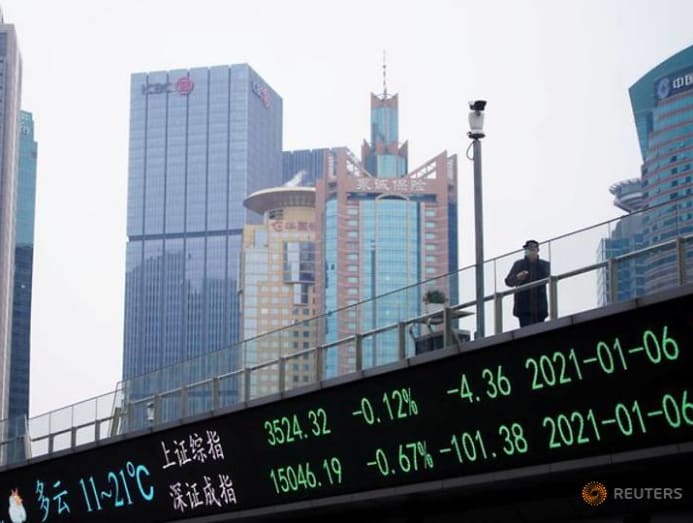
In fact, two-thirds of its "land-run" economy is now privately operated. Yet it did not achieve this with Western-style privatisation.
People's republic of china challenges traditional Western frameworks, with a policymaking approach that is long-term, pragmatic, and contextual.
Influenced by ancient Chinese philosophy, policymakers engage in complex systems thinking. They know that systems are never static, and thus cannot be fairly governed past rigid rules and procedures.
To enable continuous reform and adaptive policymaking – essential to the stability, functioning, and development of circuitous systems – flexible relational principles are often far more than useful.
READ: Commentary: China fixes 'something seriously wrong' with its economy
Technology has aided in this process of adaptation, past helping to overcome coordination and communication problems. The WeChat app, for example, links complex networks and organisations, thereby facilitating just-in-time delivery of huge and complex projects.
Another notable characteristic of Chinese policymaking is the tendency to emphasise commonage survival over private interests.
Dissimilar the United States, for example, China has extensive experience with systemic decay and collapse. Its leaders are well aware of the instability this tin can cause – and how difficult it is to rebuild.
They are thus committed to preserving, developing, and fortifying existing systems, even if it means imposing short-term costs on individuals.
READ: Commentary: Is China turning inwards?
A MATRIX OF MINDSETS
But hither, likewise, we run the take chances of reductionist thinking. Ostensibly, Cathay's approach tin be compared to those of other countries using a two-by-ii matrix, comprising MeMe and WeWe mindsets.

The United states of america – especially under sometime President Donald Trump – has long epitomised the MeMe approach, in which the collective good takes a backseat to individual rights and freedoms.
But, if its COVID-19 strategy is any indication, the Biden administration may be prepare to button the US toward a MeWe approach – still emphasising individual rights, but with an eye for the collective good – though it volition undoubtedly confront strong resistance.
Europe'due south social democracies are the poster child for this category.
READ: Commentary: Joe Biden's loftier expectations - not since 1945 has more rested on a new US leader
Asian countries, for their office, generally fall into the WeMe category, placing the commonage first, but nonetheless stressing individual rights.
China'due south emphasis on collective welfare, nonetheless, is stiff enough to place the country – forth with Cuba – in the WeWe camp. Nonetheless, demands for individual rights are growing louder in both countries.
Clearly, deepening international integration has enabled external forces to influence Chinese thinking, just equally Communist china increasingly shapes the rest of the earth.
READ: Commentary: Parts of Asia volition miss Donald Trump's tough People's republic of china policy
ZERO-SUM COMPETITION Volition LEAVE Everyone WORSE OFF
Unfortunately, such dynamic feedback loops are often treated as a zero-sum game, with countries not only clinging to familiar approaches and perspectives, but also trying to impose their means on others.
With his plan to build a concert of democracies to contain People's republic of china every bit part of an "extreme competition" between the ii powers, that is precisely what Biden is poised to exercise. This will leave everyone worse off.
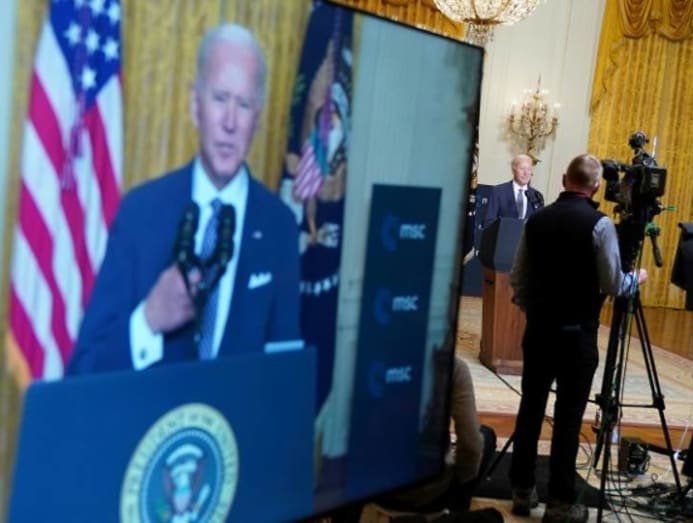
After all, as the COVID-nineteen pandemic has highlighted, global cooperation is vital to tackle transnational challenges, including terrorism, migration, inequality, and climate alter. If countries pick fights with one another, those challenges will only abound.
For now, Red china is getting its ain firm in lodge, such equally past implementing its "dual-circulation strategy," which aims to boost Communist china'due south supply-concatenation and market resiliency through increased reliance on "internal circulation".
But that strategy does non preclude cooperation. On the contrary, Mainland china welcomes greater cooperation on shared challenges, every bit long every bit that doesn't mean compromising on its primal beliefs or systems.
READ: Commentary: After a stormy few years, verdict on Trump's trade war with China is articulate
When the West is ready to cooperate – without attempting to force China to cantankerous red lines such as regime alter – devising a new global social contract volition be essential.
This ways, for starters, reforming the multilateral institutions, such equally the United Nations, the International Monetary Fund, the Globe Bank, the World Trade Organization and the World Wellness Organization.
Past involving all stakeholders, this process can foster the development of a shared narrative, with each country pinpointing its office within the global commonage.
In such a scenario, the U.s.a. and China would do their function to protect the global commons, rather than competing for global dominance.
Andrew Sheng is Distinguished Fellow at the Asia Global Plant at the University of Hong Kong and a member of the UNEP Advisory Council on Sustainable Finance. Xiao Geng, Chairman of the Hong Kong Institution for International Finance, is a professor and Director of the Inquiry Establish of Maritime Silk-Road at Peking Academy HSBC Business concern School.

Contempo Searches
Trending Topics
Source: https://cnalifestyle.channelnewsasia.com/commentary/commentary-its-own-detriment-us-still-doesnt-understand-china-295661
0 Response to "Commentary: To its own detriment, the US still doesn’t understand China"
Post a Comment